
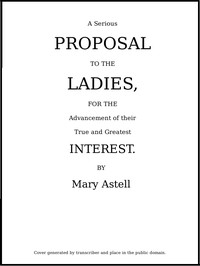
A serious proposal to the Ladies, for the advancement of their true and…
Published in 1694, Mary Astell's A Serious Proposal to the Ladies isn't a story with characters and a plot. Think of it as a direct, passionate letter to the women of her time. Astell looks at the world around her and sees intelligent women trapped. Their education, if they get any, focuses on manners and attracting a husband. Their value is tied to beauty and marriageability. Astell finds this not just unfair, but a tragic waste of human potential.
The Story
There's no traditional narrative here. Instead, Astell lays out a clear and radical plan. Part one is her famous argument: women have rational souls equal to men's, and neglecting their minds is a moral and social failure. She brilliantly points out that society calls women vain and foolish, then denies them the education that would cure those very faults. The second part gets specific. Her 'proposal' is to establish a women's academic community—a 'Monastery' or 'Religious Retirement.' This wouldn't be for nuns, but for any woman who wanted a life of the mind. It would be a safe space to study, debate, and develop virtue away from the distractions and pressures of fashionable society. It was a blueprint for a college, centuries before such a thing was considered possible for women.
Why You Should Read It
Reading Astell is like finding the root of an idea you thought was modern. Her voice is surprisingly accessible—logical, witty, and dripping with righteous frustration. You can feel her intelligence straining against the confines of her era. It’s thrilling to see her use the era's own religious arguments to support women's education. She doesn't scream for revolution; she builds an iron-clad case for it. It’s also humbling. It reminds us that the desire for a space to learn and think freely is an ancient one for women. Her 'retirement' is the ultimate fantasy of intellectual peace.
Final Verdict
This book is a must-read for anyone interested in the history of feminism, education, or just powerful ideas. It's perfect for book clubs that enjoy a good debate, as Astell's questions about society, gender, and purpose are still incredibly relevant. If you love seeing where big cultural movements began, start here. Be warned: it’s a philosophical work, not a page-turning novel. But for a short 17th-century text, it packs a punch that still lands over 300 years later. You'll finish it with a huge amount of respect for Mary Astell's brilliant, fearless mind.
This publication is available for unrestricted use. You do not need permission to reproduce this work.
Thomas Wilson
9 months agoOne of the most comprehensive guides I've read this year.
William Moore
2 years agoI was skeptical about the depth of this book at first, but the argument presented in the middle section is particularly compelling. I’ll definitely be revisiting some of these chapters again soon.
Michael Miller
10 months agoMy first impression was quite positive because the bibliography and references suggest a high level of research and authority. I'm genuinely impressed by the quality of this digital edition.
Sarah Miller
1 year agoThis was exactly the kind of deep dive I was searching for, the insights into future trends are particularly thought-provoking. If you want to master this topic, start right here.





Charles Smith
7 months agoThought-provoking and well-organized content.